
By Celia Atherton, PhD researcher for Coram and Newcastle University
Warning: Some of the historical language used in this article may be seen as offensive. Find out more about the historical language in our archive. Please also note a conscious decision to capitalise ‘Disabled Children’ has been made by the author, to emphasise the term’s political significance in line with Disability Rights UK and SPECTRUM.
Our PhD researcher, Celia, focuses on the Ackworth Branch of the Foundling Hospital. Ackworth was where the majority of Disabled Children within the system of the Hospital were cared for, and this article shares the story of some of these children through a mass apprenticeship.
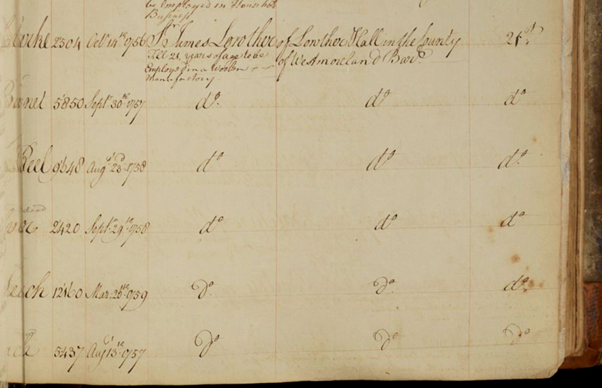
Apprenticeship records of children apprenticed to Sir James Lowther, taken from Apprenticeship Register, volume 2, CFH/A/12/003/002 https://archives.coram.org.uk/records/CFH/A/12/003/002 (accessed 7th September 2026 by author)
Ackworth Branch Hospital
In 1756, the Foundling Hospital secured a parliamentary grant to support the children in its care, on the condition that any child above two months of age brought to the Hospital’s door had to be accepted. This period of indiscriminate entry was styled the ‘General Reception’ and lasted from June 1756 to March 1760. Due to the sheer number of children taken in by the Hospital, six branches were established to help care for these children. Ackworth was opened in 1757, Shrewsbury in 1758, Aylesbury in 1760, Westerham in 1760, Barnet in 1762 and Chester in 1763.
Ackworth was the largest of the branches, caring for 2,665 children until its closure in 1773. The main aim of the Ackworth committee was to apprentice out the children in their care, so they could be made ‘useful to the public’. Although most apprenticeships were to individual masters, the Ackworth committee sometimes apprenticed out groups of children to a single employer, as was the case with Sir James Lowther.
Sir James Lowther
Sir James Lowther Bt., of Lowther Hall in Westmorland, was one of the wealthiest men of his age. Born in 1736, Lowther went on to inherit Lowther Hall from the third Viscount Lonsdale in 1751. He later became the first Earl of Lonsdale, and in 1761 was married to Lady Mary Stuart, daughter of the third Earl of Bute. He was heavily involved in the politics of the era, helping secure election victories for his friends. Lowther also owned extensive land and colliery interests in West Cumberland, including a carpet manufactory in Westmorland. His business interests led the Duke of Newcastle to tell George II that Lowther was ‘perhaps the richest subject that His Majesty has’.
1772 Apprenticeships
In July 1772, Lowther requested that twenty-three girls, aged twelve and above, be ‘set apart’ at Ackworth to be employed in his carpet manufactory. Issues began to arise when Lowther continually did not send for the children. Sir Charles Whitworth (Treasurer of the London Hospital) wrote of his frustration at the matter, as the children ‘should not be kept at uncertainty but be apprenticed wherever masters can be procured’.
Lowther had still not sent for the children by October 1772, and the Rev. Dr. Lee (de facto secretary of the Ackworth branch) wrote how they had begun to apprentice the children out as they could no longer hold them aside for Lowther. Lee vented his frustration to Lowther himself, writing that ‘it is of the greatest disservice to the charity to set apart children who are not taken away according to the time’.
Lowther’s enquiries to the Hospital
Children were eventually sent to Lowther but in January 1773 Lowther complained about the ‘condition’ of the children. Thomas Collingwood (secretary of the London Hospital) ordered Dr. Lee to create a list of the children to determine the ‘state of the condition they were in; and whether they had any natural infirmities or defects’.
Dr. Lee sent the list to London, ‘with an assurance of my firm belief, that they were all in perfect health, and had not any natural infirmities or defects excepting those mentioned in the list’. He defends the choice of children sent to Lowther, arguing that Lowther ‘delayed so long his sending for them’ that he followed Collingwood’s own orders to apprentice the children elsewhere if ‘proper masters’ were found. Some of the original children were then apprenticed to other masters, and children with what were regarded as impairments were then used to make up the number.
Dr. Lee’s knowledge of the children
Lee gave a personalised account of the children, arguing that they were capable of the work Lowther required:
two of these indeed had lost each an eye but were fit for any business; and one other, whose eyes were rather tender at that time, but never so bad as to prevent her doing business as this. Bona Clarke, was the stoutest girl amongst them and as sir Charles in his letter of the 15 July mentioned 3 girls to be older for servants, she was sent with that view, as well as Ann Peach. The others ‘tho of small stature for their age were fine girls and one ‘tho deformed, an excellent proficient at the needle.
Lee had long seen Ackworth as the most appropriate place for the Disabled Children within the whole Foundling branch network, and in 1769 had given a similar personalised account of the work some children were employed in:
we have no child but can do something except Rebecca Baker even Bob Brown at sometimes can both pump water and drive up the cows. Humphrey May and Sampson Jones can work at the Pump and lease wool, Drucilla Bruce can knitt a little bit Rebecca Baker less
The lives of these children were consequently shaped by the Hospital committee’s personal understandings of their impairments. The Lowther case gives insight into how institutional and personal perceptions of these children had a direct impact on their experience of work outside the Hospital.
Bibliography
Coram Foundling Hospital Archive, London Archives, A/FH/Q/01/011, Letter from Lee to Collingwood, 13th November 1769
Coram Foundling Hospital Archive, London Archives, A/FH/Q/01/012, Letter from Lee to Whitworth, 6th October 1772
Coram Foundling Hospital Archive, London Archives, A/FH/Q/01/012, Letter from Lee to Lowther, 20th October 1772
Coram Foundling Hospital Archive, London Archives, A/FH/Q/01/012, Letter from Lee to Collingwood, 25th January 1773
Coram Foundling Hospital Archive, London Archives, A/FH/Q/01/015, Letter from Collingwood to Lee, 15th July 1772
Coram Foundling Hospital Archive, London Archives, A/FH/Q/01/015, Letter from Whitworth to Lee, 22nd August 1772
Coram Foundling Hospital Archive, London Archives, A/FH/Q/01/015, Letter from Collingwood to Lee, 20th January 1773
Coram Story, Branch Foundling Hospitals, https://coramstory.org.uk/explore/content/article/branch-foundling-hospitals/ (accessed 8/7/26)
David Allin, The Early Years of the Foundling Hospital (privately published, 2010)
Disability Rights UK, ‘Social Model of Disability: Language’, https://www.disabilityrightsuk.org/social-model-disability-language?srsltid=AfmBOooTfbRhV32cx5OITxUrdnCmjeiij1haGE0RD7TenIjux5_U-6PZ (accessed 23/5/26)
Oxford Dictionary of National Biography, ‘Lowther, James, earl of Lonsdale’, https://www.oxforddnb.com/display/10.1093/ref:odnb/9780198614128.001.0001/odnb-9780198614128-e-17110 (accessed 14/7/26)
Ruth McClure, Coram’s Children (New Haven, 1981)
SPECTRUM centre for independent living, ‘Sticks and Stones: The Language of Disability’, https://spectrumcil.co.uk/wp-content/uploads/2018/02/ULO19-The-Language-of-Disability.pdf (accessed 23/5/26)