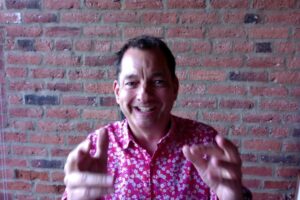
Simon today
I was born on 4 January 1967 and adopted at five weeks old. I was told about being adopted so early that I don’t remember ever not knowing. Adoption wasn’t a biggie. It just was. I saw my adoptive parents as my real parents because they were. My birth parents never crossed my mind.
That remained true right into adulthood. I built a life, worked in the family business, eventually ran one of the companies, fell in love and married Lynn in 1997. Through all those milestones I still never thought about my birth mother.
On my 40th birthday in 2007 that changed.
My parents collected me and Lynn to go to the pub for dinner to celebrate. They brought a box of things I had left behind in the bedroom I’d moved out of 18 years earlier, including my teddy bear. My dad told Lynn that Ted was from my birth mother. Lynn told me later. My first reaction was gentle curiosity. They had told me I was adopted, so why hadn’t they told me who had given me the bear?
A couple of months later I shared the Ted story with Sarah, a coach, and something inside me erupted. I went from calm to volcanic. The words that came out of my mouth shocked me as much as they shocked her…
“She didn’t ******* love me enough to *******keep me. What’s the teddy? Some sort of consolation prize?”
“I’m a mum, Simon. And I don’t think it would have been like that,” she replied.
I saw the truth in her words and the eruption stopped as quickly as it had started. Meanwhile my business had finally had a great year profit-wise. It had taken me thirteen years to get there. My business coach insisted I reward myself, so I went on my second ski trip in as many months. I remember staring out across the snow after a fantastic day of perfect blue skies and great skiing. Nothing had changed. I felt exactly the same. The fear of failure hadn’t lifted. The worry hadn’t stopped. Where was I to find happiness.
That realisation set me on a journey I didn’t know I needed to take until then. On a retreat in 2009 old memories resurfaced and began to make more sense as I told my story…
One of the most painful parts came was when I was eight. I thought that I’d failed the exam determining whether I stayed at the same school as my best friend Eddie. He had already received his letter saying he had passed. Mine wasn’t waiting for me when I got home. I clung to my mum, sobbing uncontrollably, utterly convinced I was losing him. The next day my letter arrived and I had passed.
Another terrible memory came from Scout camp when I was eleven. I was new to the troop and the older boy in charge of our tent singled me out and whenever I made a mistake he made me kneel on the grass and repeat I am a f******* worthless piece of s***. I was terrified and complied. That shame welded itself into me in ways I did not understand until the retreat.
Then there was the party when I was seventeen. One of the cool lads demanded to know why I was there, his tone dripping with contempt. I stormed outside and found myself picking up a smooth stone from the ground, heavy in my palm. I held it tightly, thinking that if he said one word to me I would smash him in the face. Thankfully he didn’t talk or event look at me again. At the time I saw it as teenage anger. After the Ted eruption it felt different. I began wondering what was adoption related and what wasn’t.
Adulthood brought more generalised pain. Running my business was a constant source of fear of failing…of not being good enough. I thought that was just business. The retreat pointed me towards a new way of seeing this. I realised the voice in my head was a liar and definitely wasn’t me. I had nothing to prove. I wasn’t my business. And so I began focusing on personal as well as business development.
A couple of years after the retreat I sold the business and, out of the blue, had the idea of making a living helping others. A few years after that, a conflict in a business group pushed me to look for help again. The leader – who knew some of my story – told me bluntly to get some, saying it was adoption-related. I typed “adoption helpline” into Google and one of the recommendations was The Primal Wound. I ordered it and read it from cover to cover as soon as it arrived.
At first it brought huge relief. It felt as if someone had finally explained everything I was feeling. Then the relief faded and I felt stuck. After a coaching call something shifted. I realised I wasn’t wounded after all, because who we truly are is unwoundable.
As things settled, I realised I wanted to know more about my roots. I started the process of searching. It took time, forms, waiting and more waiting.
Eventually I sat with the post adoption worker as he handed me a document. I was expecting to see my birth mother’s name on it. And I did. Patricia Joan Flower. But I also saw the name she had given me too…David Anthony Flower.
Not long after, in a therapy session, something cracked open. A picture of Pat outside the therapist’s room popped into my mind. Something in her face said rejection. I froze in terror, then flushed with heat. I’m not going to let this fear hang over me, I thought. I am going to resume the search.
Eventually I got my l adoption file. I learned that my birth mother, Patricia, had planned everything to make sure I went to a secure home with two loving parents. I learned that my birth father denied responsibility and disappeared.
A reference to the teddy bear was yet to come…
I drove home and half an hour later found the letter to the social worker she’d wrote four days after handing me over. She explained that she had meant to buy me a teddy bear in Liverpool but had run out of time because of heavy traffic. She felt awful. She asked if she could send a teddy on so that I would have something from her.
Tears cascaded down my face. It was as if the decades between us dissolved and suddenly I could feel her as she wrote it, a young woman heartbroken and grieving, trying to hold herself together, wanting her son to have something of hers. All the feelings of being unloved collapsed in a moment. I saw plainly that she had loved me deeply. I felt completely connected to her. I merged with her. An other-worldly experience.
Once I had her name, I wanted to find her. I started googling. All I could find was the mention of the death of a Patricia Flower on a church website. Beverlie Flower was listed as someone who had made a donation after Patricia’s death. Sister, daughter or mother, I didn’t know. I tracked down a Beverlie Flower and wrote to her. Nine months later an envelope with a Canadian stamp arrived. It was a letter from Michael Flower. He had found my letter while sorting Beverlie’s post after her death. Beverlie was Patricia’s sister. Michael was their brother. My birth uncle.
Good news, I had found the right family. Bad news, my birth mother had died. There was no chance to meet her. I was oddly numb. But not in a bad way. The teddy bear letter I had read so many times had been full of her love. That love somehow insulated me from the grief.
In 2020 another insight or instinct arrived – to find my place helping others in the adoption world. Since then I have interviewed over six hundred adoptees, adoption professionals, adoptive parents and birth parents for the Thriving Adoptees podcast.
Many of those conversation have helped me realise how lucky I got with my parents. They focused on me, not themselves. They simply loved me. They gave me stability, warmth and the sense that I belonged exactly where I was.
I’ve also learned that many of us who were adopted as infants only see adoption’s impact in middle age, when the subconscious, pre-verbal trauma becomes conscious. This process is called coming out of the fog. It reveals the storm of trauma that was previously invisible. If we are really lucky, we see that we are the sky, the open, peaceful space that the storm doesn’t damage.
If I’ve had a primal wound, mine is a paper cut. And healing can be seen on two levels. On one level, all of us, adopted or not, have endured trauma and will continue to heal. But at a deeper, more fundamental level, we are unwounded because our essence is unwoundable. Beneath our psychology we are whole. Intact. Trauma conceals our core, it does not cut it.
I’ve distilled all my learnings about what helps us thrive into the THRIVE Framework. And I share that with others through in-person and online trainings.
Simon Benn
Founder, Thriving Adoptees