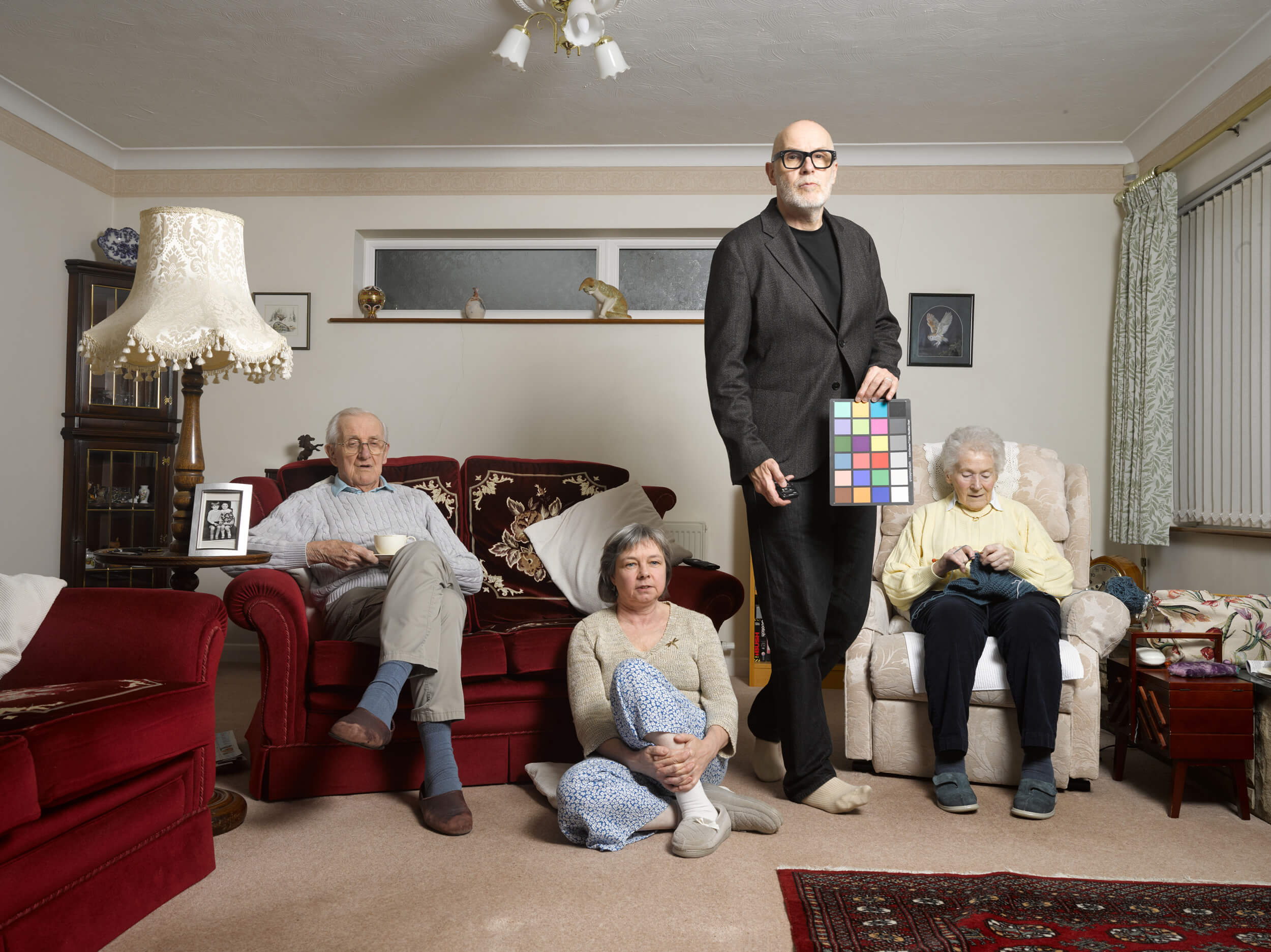
Richard & his family.
Photo Richard Ansett 2026.
I don’t remember ever being told I was adopted, but I feel like I’ve always known. I’m not sure if my parents planned it that way but it was a wonderful way of feeling like I was part of the family, while knowing I was adopted.
I spent my life, up until my mid-to-late forties, not having any information about my adoption – not asking and not caring. It was only in midlife that things changed for me and it occurred to me, that my biological mother deserved the right to contact me and that I should offer her that opportunity and open the door.
It became a thought that would not go away, to such an extent that it was affecting my day-to-day life. Eventually I decided to do something and began the process of contacting the local authority that had conducted my adoption and asked to see my file. I went to their offices, where I had my first experience of a counselling room: a bleak, rather empty space, with a half-dead pot plant, two chairs and a box of tissues.
They brought out the file and I was introduced to the fragments of my biological parents’ lives for the first time. I remember that the more I read, the less I felt I understood but there was a page written by my biological mother, explaining the reasons why she had given me up for adoption. Regardless of the veracity of the words, the thing that was most powerful for me was that it was written in her own hand.
Suddenly I was looking at her handwriting and I was overwhelmed, I felt like she was in the room with me. As an artist and especially a photographer, I am drawn to the visual and the one thing I felt I could trust was the reality of my biological mother’s hand creating those words and I felt close to her in that moment.
At that point, I thought it would be worth exploring further and I contacted a professional adoption investigator. I really didn’t want to do it myself and thought that, by commissioning someone, I’d create some distance and keep a sense of control. I think there were a lot of unresolved feelings that I hadn’t even started to examine.
My birth certificate, by the way, has no father on it. I don’t know if that’s common but it seems a little unfair to place all the complicated feelings on my mother when my father was entirely absent. To me, this absence has its own weight as important as the presence of my mother – being there and having to go through the process of letting me go.
The private detective found out that my mother lived in Hull, she was married and didn’t have any other children. There was an attempt at contact, carefully through a friend of hers who communicated on my mother’s behalf. It turned out that she had never told her husband that she’d had a child. It was also made clear that my mother didn’t want to take things any further but did want to know if I was healthy and happy.
Managing what felt like a wave of second rejection, I accepted her decision and shared some personal information to be passed on so that she would have ‘her’ answers. Afterwards and to this day, I regret doing so as though I’d somehow lost a bargaining chip that I could have used to maybe nudge her towards the possibility of further communication.
The child in me felt a second abandonment and I had to manage that and try to balance it with empathy for my biological mother’s needs. But I had to think about my needs too. I decided I would write a journal and knowing that she lived in Hull, travel there writing my feelings down as I sat on the train from London. I would arrive in Hull and be as close to her as I could. I thought that this might be a way to help me process the feelings.
On arrival at the station as I walked out into Hull city centre, amongst the crowds I immediately became aware of women of a certain age, all of whom could actually be my mother.
I’ve always used the camera as a way to engage with the world. It has always been there, a silent partner, the one constant through all my triumphs and crises. However, I had not brought a camera on this trip so I bought some disposable cameras and began discreetly to photograph all these women from a safe distance (a metaphor in itself). I was conscious of not breaking the boundary that my biological mother had set, which was being acted out in these photographs. The women didn’t know I was there or that I was taking their picture. They might be glimpsed in a crowd or captured through a café window or as they crossed a road.
It is important to stress that none of this was pre-meditated, it was entirely unplanned as a ‘project’ – I was led by pure emotion. I spent the day taking these photographs and then I went back home with a collection of images of old ladies. I didn’t feel a pressing need to do anything with them – the process of taking them was more important than the pictures themselves. They were so deeply personal it didn’t occur to me to show them. So they were packed away along with my adoption records. Suddenly I was sleeping again, everything was fine. I accepted my biological mother’s decision and life returned to normal.
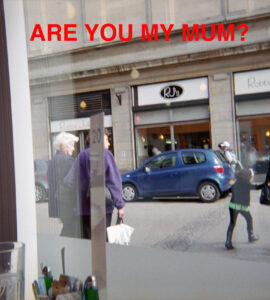
An image from the “Are You My Mum?” project.
For many years I didn’t think about those pictures, until Hull was announced as City of Culture. I hadn’t viewed the Hull pictures as an art project when I made them but now this felt like an opportunity to consider showing them. I would need to think carefully about what they meant and how they might be perceived. I was particularly concerned that the project was inspired, to some degree, by unresolved feelings of abandonment. However, I felt it could be possible to create a project that could contain some of those emotions without explicitly addressing them or exposing anyone to potential harm. I came up with the idea of a ‘lost-cat’ style poster campaign. There were no details, no QR code and no contact number. It was just posters of the images printed out on a photocopier with “Are you my Mum?” written on them.
I spent three days walking around the city fixing over 200 posters to lampposts, bus stops and walls.
My concerns about the project’s reception were dispelled quickly when Coram got in touch and invited me to talk about it. I started to realise that there were people out there who really had a very good understanding of what I was trying to do and I was incredibly touched by that. I felt like the hurt child in me was being recognised and nurtured once again.
In my mind, adoption is like a coin with two sides. One side of the coin is rescue and the other is abandonment. The two sides must co-exist otherwise there’s no coin. I think it’s really important to recognise that when you’re showered with unconditional love as an adopted child. Our new life always sits alongside a pathway we’ve been taken from.
Although my adoptive mum and dad, have always been very supportive and open to talking about my adoption, I never felt comfortable asking questions. I always felt there was a hurt in my adoptive mother that I didn’t want to expose. My exploration of my past and the subsequent project “Are you my Mum?”was done without their knowledge and it felt like I was doing it behind their backs. Since that project and making contact with my biological mother, I’ve been more open about my adoption with them and in my practice.
My adoptive parents gave us every opportunity to find our passion and significantly, they introduced photography to me at a crucial time in my development and I thank them. The camera introduced this amazing opportunity – even before I knew it – to poke around people’s lives, to see how they live and also to have this intimacy with my subjects that I couldn’t have without a camera.
I’m always present in the room with the people I photograph but there’s this distance too – a projection that the camera documents. A therapist once told me that I reminded them of Tiny Tim from A Christmas Carol – impoverished looking through the window observing the Cratchet’s perfect family Christmas. I thought that was an amazing metaphor for the camera as well, because the camera is the plane of the glass, that layer between experiencing something and actually being part of it – of both presence and absence.
The new project I’ve created especially for Coram, ‘Next of Kin: A Portrait of Adoptive Families’, is about other people’s experiences, while also acknowledging my own. I’m still processing what it means. With my mental health training and my Samaritan work, I understand how careful we must be with other people’s feelings. Now I feel like it’s my turn to be looked after and I feel very well cared for by the Coram team.
I greatly value being invited into the adoption community and perhaps can inspire those who maybe struggling with their sense of place to. I feel like the dislocated, tribeless artist, actually does have a sense of belonging after all. I feel seen and understood by the Coram family and I’m grateful for that.