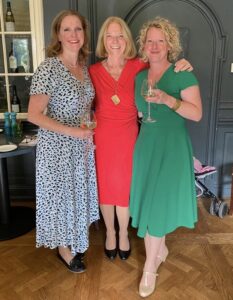
Pat and her daughters
I was born in September 1950 and adopted when I was eight months old. My mother had been married before, but after her husband came back from the war the marriage broke down. They had a son, seven years my senior.
My natural father was too young to fight in the Second World War but he served with the Gurkhas and spent time in Afghanistan and India. He came back to England in 1948 and his parents bought him a farm in Suffolk. My mother was living and working in Southwold which, at that time, was a small close-knit coastal community that has changed little over the years. She met my father in 1949.
I was born in a nursing home in Kessingland, near Great Yarmouth, the older by five minutes of identical twin girls. My natural father—or rather his parents—decided that my mother wasn’t the right match for my father therefore marriage was out of the question. However, monthly maintenance was paid for us.
Contrary to her expectations, my mother found herself on her own in Southwold with our brother, aged 7, and twin girls. It was essential she worked and my sister and I were put into a day Nursery because of this. It was there that we both contracted gastro-enteritis at six months old. As we were not expected to survive, we were christened by the Matron of the hospital. Very sadly my twin sister died.
Obviously, that had a huge effect on my mother, who was 27 years old. It was a very complex, painful situation for her and as a result I was put up for adoption and my older brother went to live with other members of the family for a few months.
I was adopted by Betty and Ken, who were 35 and 45, much older than my natural parents. We lived in Woodbridge, and the first photograph I have of myself is from my church christening when I was about nine months old.
People sometimes say, “You don’t have many photos,” but of course you didn’t in 1951. We didn’t live our lives through cameras then.
We stayed in Suffolk until I was about two, and then my parents moved around for work. My adoptive father had served in the war for five years, in North Africa, Italy, all over. He’d had a broken marriage and no children before marrying my mother in 1948. They couldn’t have children, so they adopted me, and I grew up as an only child.
We moved a lot— Essex, Berkshire, Wales – wherever my father could find work, often in estate management. I think the war affected him deeply. Eventually, in 1955, we settled in Sussex and stayed in one house for about ten years, which was unusual for us. It was a very settled, very happy childhood. We lived in the middle of the countryside and I was lucky enough to have a pony from a rescue centre. My parents were advised that having a pony would be good for me because I was on my own and lived a few miles away from the local village and my primary school.
Looking back to my early childhood, it was lonely and I often wished I had siblings.
I always knew I was adopted. I can’t remember not knowing. That’s probably the best way. But there’s always a question mark over your head. You really do fantasise about who your parents are and what might have been.
My parents were very old-fashioned. Born in 1906 in London, my father was an
Edwardian gentleman. He came from a privileged but disciplined background and was distant and proper. My mother also came from London and was a warm, very loving lady.
Despite often thinking about where I came from I felt very secure and loved.
When I was 16 I asked for more information about my birth parents and they gave me my birth certificate. There was no father’s name on it, and that stirred things up again in my mind. I went into the Sixth Form to do my A Levels with a view to perhaps going to University, I didn’t really know. What I did know was that I wanted to travel. Not just for a few months, but to work abroad. I left school before finishing A-levels and trained as a secretary because I thought that would be the quickest way to achieve my goal.
After a year at College I worked in London in advertising and television, which was fantastic great fun! I commuted to London and then lived there in a flat-share.
London in the late 1960s was definitely the place to be.
After a couple of years I applied to work at NATO, was accepted and in 1971, aged 21, I joined the International Staff at NATO in Brussels. I travelled by train, on my own with just two suitcases, to start my new life. It was fascinating and very scary to start with, but I enjoyed the international environment very much. I met my future husband there who was Dutch and moved to The Hague with him in 1974, married, and had two daughters. My adoptive mother died of cancer in 1976 so my adoptive father was on his own at the age of 69. In 1983 he came to live with us in the Netherlands.
In 1987 my husband died, leaving me with two children and my father. In 1989 we returned to England, to North Devon. I decided it was time to look for my family. By then the law had changed and I was able to access my adoption records and it was confirmed that I had an older brother from my mother’s first marriage. I wrote to my brother through official channels, and nine months later, just prior to Christmas 1990, he replied. He told me that our mother had married again and that I had five more siblings. That changed everything in my life.
In 1991, together with my partner and my two daughters, I met my (half) siblings: three brothers and three sisters, the youngest two sisters are non-identical twins. It was a joyous, somewhat overwhelming occasion for all of us. We were made so welcome and it was interesting to hear that they all knew about me and my twin sister. We’re similar and different, all at once. We’ve stayed in close touch ever since. Very sadly our mother died in 1984 so I have not met her.
I later searched for my father. I had a strong feeling he’d gone to Australia, which turned out to be true. I found him in 2011 and went to Australia to meet him and his three other daughters, my sisters. (My Australian sisters had also known that our
father had twin daughters in the UK). For the first time, aged 61, I celebrated my birthday with one of my parents. I visited him several times before he died aged 96 in 2022. Both my daughters and two of my four granddaughters have met their grandfather as well.
Meeting my biological families was extraordinary. The first people I met genetically related to me were my daughters. Then my siblings in the UK and then my father and siblings in Australia. One of my brothers once said, “You’re exactly like our mother. You don’t have to say anything as I know what you’re going to say.” As I’d never met her that was deeply moving as well as very amusing.
Adoption doesn’t just affect the adoptee. It affects everyone—children, partners, extended family. It’s a whole jigsaw. Nobody prepares you for that. I have had enormous support from my family, throughout my life which has made everything so much easier. It was a huge decision to try to trace my families and without the support of my two daughters and my partner (now husband) it would have been extremely difficult.
Although my adoptive Mum was not alive when I found my family I know I would have had her support as well. My adoptive Father did meet one of my sisters and one of my brothers in England before he died which was wonderful.
I’ve never felt bitterness and anger, I’ve always felt curiosity. You can’t judge the past by today’s standards and the world was very different and far less tolerant for women in the early 1950s. Women had few rights.
Looking back now, at 75, I feel incredibly fortunate. I was lucky, my parents were wonderful, very loving and supportive. All my siblings and their families have given us so much love and we are all very much a part of their lives. It all seems to fit.
My life has been shaped by adoption but it’s been defined by connections and love, not by loss.