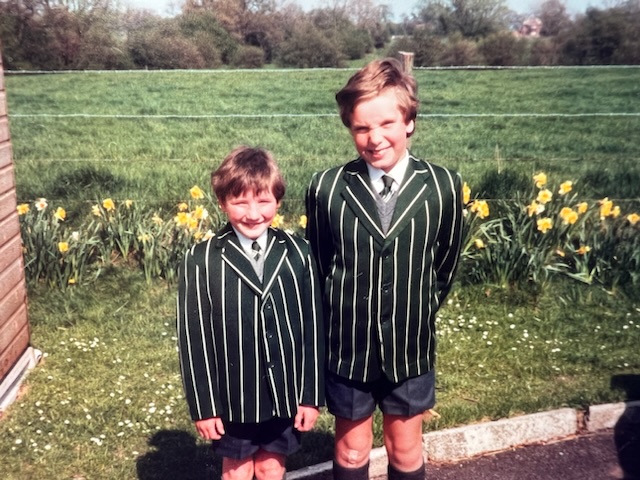
Oliver & Edward Simpson
Oliver’s Story
I was born just before the heatwave of ’76. As far as I’m aware, my father was never on the scene, so my just 18‑year‑old mother was on her own. She came from a large family; however, I think she received very little positive support.
Two years later, my half-sister was born. My mother was already struggling, but I think with the birth of her second child, what was extremely difficult for her suddenly became impossible.
My first memory is running around the estate in my nappy, normally heading to my nan’s house down the street. Most of my memories of my nan were positive; however, like many alcoholics, once she drank too much, she became a different person. She would lock me in a cabinet to control me or punish me for being naughty—an extreme version of the “naughty step”, I suppose. She would also let me stay up until the national anthem came on the TV when it shut down for the night. Despite all this, I always wanted to go there. I can’t fully remember what was happening at my mum’s house, but for me to prefer my nan’s, it couldn’t have been good.
As the next few years went by, my behaviour obviously deteriorated due to the lack of real discipline and routine. I didn’t go to nursery or school—I was just running around the estate, as I knew most of the people on the street by then. They would often treat me to a drink or a sweet. Looking back, I think they felt sorry for me. At that point, I was very small and underweight for my age.
At nearly five years old, my mother placed me into the care system. I bounced between foster carers and a children’s home for the next couple of years. The main reason was that the foster carers couldn’t cope with my increasingly difficult behaviour. I also believed that, at some point, they would give up and I would be sent back to my mum.
I went to my final foster home when I was nearly seven. My behaviour hadn’t improved, and my trust in people was completely gone. I did, however, love animals, and luckily my new home had dogs, cats, and a horse, as well as their children, who were all older than me—a girl, Victoria and two boys, James and Edward. I began my usual testing of the family, assuming I would be back in a children’s home soon. However, the opposite happened. I remember my now-parents discussing adoption with me, and thinking, “Well, this is new!”
I was adopted by my wonderful parents Alex and John at around seven and a half. I think they believed my behaviour would quickly improve, as my life was now full of love and far more stable than ever before. How wrong they were. I continued to test them for many years. Although I felt loved and safe, I was always waiting for it to go horribly wrong—and I was certainly doing my best to make it happen. Like a lot of children in my position, self-sabotage was high on the agenda, although I didn’t understand that at the time.
My parents also fostered many children during my childhood—over 90 by the time they retired—as well as adopting one more. How they managed everything, I still don’t know.
As I reached my teens, I started smoking and later taking drugs—weed and ecstasy—basically living for the weekend. My GCSE results were poor, although I did manage to get five passes or above. Looking back, I often wonder how I might have done if I had put in some effort.
My school life wasn’t much different from my early years—I was bounced from one school to another, often with my parents being advised to move me on before the decision was taken out of their hands. I even went to a school for troubled children. It was an eye-opener. I suddenly went from being one of the naughtiest kids in the school to one of the best—without really changing my behaviour.
When it came to my adoption, I’m afraid my mum took the brunt of my anger and frustration. I wasn’t physically violent, but I was disobedient, verbally abusive, and disruptive. I struggled to be told what to do after years of fending for myself.
I still feel a great deal of guilt, as I sadly lost my mum 10 years ago. Although we made up and spoke openly before she passed, it was only then that I truly understood how difficult I had made her life—and just how much I loved her. My birth mother died a few years after. I was saddened by her passing, but I was devastated when I lost my mum.
My dad has always been my rock—my biggest supporter (and defender)—seeing something in me that I didn’t see in myself. He has always been dependable and consistent. Now, as a father myself, I often try to mirror him.
I know this may sound like I’m lacking emotion, but looking back, the only way I can describe how I felt during most of that time is anger. Every emotion I had became anger. Now I understand it as “survival mode”—like someone who has just lost everything in a fire or flood. In that moment, you’re simply trying to survive. That’s how I felt all the time. It slowly diminished over the years, but it didn’t truly go away until I looked at my daughter for the very first time. I was now in my 40s, and suddenly I had someone far more important than myself. I had always promised that if I ever became a father, I would be the best one I could be.
I’d like to finish with a huge thank you to my family for their love, support, and—above all—patience. I love you all.
Edward’s Story
I was born in Cheshire on Boxing Day in 1973, the youngest of John and Alex’s three children. Bar a nasty bout of gastroenteritis as a baby, my first five years of life were fairly uneventful but deeply nurturing. Playing on the see-saw in the garden, kicking or throwing any ball within reach and loving being around my mum made for happy beginnings.
Then one day when I was six, my sheltered upbringing was gate-crashed by the arrival of two blond haired toddlers that reshaped our family that initially left me confused and jealous. In fact, I was so miffed at having to share my home with what turned out to be the first two of the ninety foster children we looked after, that I ran up to my bedroom, barricaded myself in and refused to come out until they left.
Competing for my mother’s time and affection, losing sole use of my toys, handling the increased chaos, noise and swear word count in the family home – all proved difficult to absorb and understand. I didn’t really know what was going on, why and what it meant for me.
However, after a few years I began to find a way to cope and then involve myself in the caring side. My parents always made sure they never fostered a child older than me (except respite care for a teenager with down syndrome), which was a sensible move.
By the time Oliver arrived from a children’s home I was eight years old and better versed in the difficulties and delights that came with fostering. I remember the first time I met Oliver we went to Tatton Park to go for a walk and get to know each other. Oliver ended up walking through a field of nettles in his shorts and being stung all over his legs. He said it didn’t hurt but that’s because his defences were up and he was programmed not to show any weaknesses.
Not long after Oliver came to live with us, my mum, who had been so taken with him, announced that we were going to adopt Oliver into our family. As the baby of the family, I had mixed feelings. On the one hand I loved being my parents’ last, on the other I could see how much joy (and exasperation!) Oliver brought them. Despite some initial resentment, I’d also become fond of Oliver and was willing to embrace all that he brought with him, even the anguish and frustration that much of his behaviour generated. Whilst he struggled with trusting others, Oliver was opening up more and showing a softer more personable side.
At heart, Oliver is a lovely human being who wants to love and be loved. There were plenty of times over the years when this got pushed aside by the early life trauma he had experienced. He frequently ran away from school and home, (often at the most inconvenient times like just before we were off to the airport to go on holiday) and even stole my car when he was fifteen and drove it from Cheshire to Leicestershire and back. The culmination was when I had to pick him up from a police station having been arrested the night before outside a pub. Whilst nothing came of it, it was clear that Oliver was still dealing with his demons. Sadly, therapy as we know it today wasn’t available during his early years when it would have really helped him.
By now, I had become a family law barrister, specialising in children’s cases including care and adoption. Having that first-hand knowledge of what it was truly like for children in care and those like Oliver going through adoption was invaluable in providing insight into why they react the way they do and what is likely to be the best type of family placement.
When I was fourteen, my parents adopted another child, this time a new-born baby. The wider age-gap, the contrasting circumstances surrounding the adoption and my more mature attitude to the reasons behind it has led to a very different adoption story and experience, a reminder that like every child, every adoption is unique.
The one consistent has been, through thick and thin, as a family we have stayed committed to and supportive of each other. For Oliver to eventually develop genuine relationships built on trust has taken decades, but ultimately, through the love of his wife, children and adoptive family, he has found peace, happiness and purpose in his life.
When he ran through those nettles all those years ago, none of us could have predicted how our adoption story would unfold. For me, adoption has ended up shaping me more than I ever realised. I remain convinced that, if my parents had never fostered nor adopted and Oliver not been part of our lives, I would never have become Children’s Minster.
Oliver and I live just down the road from each other. We often go to watch Manchester City together and our own two families are firm friends. We also share a bond built around our love for and gratitude to our parents, our deep sadness at the loss of our mum and yes, our adoption story.