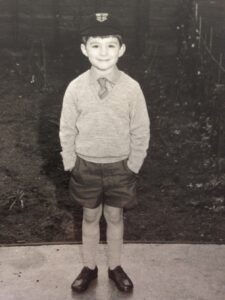
Mike Fleetham, 1971
A person who happens to be adopted
In early 1966 two first-year students at Nottingham University took their extra-curricular activities a little too far and, nine months later, I was born. Thirty years after that, I met them both again. Here’s what happened in between.
I am luckier than some adoptees. I have a few records describing my early life and the process of my adoption. I know how I was born and when. I know who fostered me and where. I know who vouched for my adoptive parents. I know the names of social workers, midwives, doctors, court officers, police officers, family friends, priests, and birth relatives who died before I could meet them; ‘third parties’ involved in my story whose names, under current data laws, would be redacted should I seek my history again. And I know my birth parents.
My mother was admitted to the Firs Maternity Hospital in Nottingham one cold winter evening and, at 11:15pm the following day, I arrived. My father visited me there, as did my maternal grandmother who ‘would not look at the baby’.
A few days later, just before Christmas, the nurse in charge, “a frustrated middle-aged spinster,” as my mother put it, told her I needed to be weighed again. She took me away, and I was never returned. It was deemed the right thing to do, avoiding any unnecessary separation-emotion on my mother’s part; no unseemly public wailing and crying.
I spend my first Christmas day in foster care in a north Nottingham suburb. Records of this part of my life are conspicuous by their absence, and as I write, I am still battling gatekeepers and legislators to find out what kind of foster care I received – care that my mother had to pay for. I can guess. Advice in the 60s was clear: don’t form an attachment with the baby. Just provide practical care. Feed him, change him, keep him warm. Don’t, by any means, begin to love him – it will be so much harder for the adoptive parents if he’s become attached to you and you’ve become fond of him. I’ve unpicked that one over the years with amazing professionals, but the legacy of this kind of formative pre-verbal experience is still unacknowledged by many carers and educators who should know better.
My adoption was managed by the Southwell Board for Moral Welfare. In the 60s, adoption was a matter of morality and political pragmatism, unlike today when it is often a life-and-death safeguarding issue. My adoptive parents ‘chose’ me at six weeks old and were permitted to take me home there and then. The court order for my official adoption is dated four months after that. Thus were laws interpreted and navigated in 1967.
My childhood was lonely, solitary, intellectual. The adopted only child of older parents, I lived in fiction books and mathematics. I struggled to fit in and took on the quiet, introverted persona of pleasing others, doing the right thing, following the rules – in my head, to prevent another rejection. I chose compliance over conflict, acquiescence over argument. It was safer, if only to park this energy and emotion for later in my life.
My father, a school inspector, gave me logic and an analytical mind; my mother, a housewife, taught me unconditional love – a gift which I have preserved and passed on to my own two (birth) children. However, my father also endowed me with an emotional constipation bettered only by my mother’s fragile self-confidence. I wept at my mother’s last breath. I’m still waiting to grieve my father properly.
I was told about my adoption aged five. You’re special, you’re chosen, we selected you! This was a practiced narrative I carried clumsily until I hit puberty, when it fell apart. If I’m so special, why did my mother give me up? If I’m so chosen, why do I feel so rejected? I scrabbled for an identity but found no foundation upon which to build it. In mitigation, my adoptive parents went up into the attic and brought down a pen portrait of my birth parents; a copy of two typewritten paragraphs describing a couple who were very much in love, met at university, enjoyed a range of sports played to county and national level, were studying engineering, and yet were unable to care for the baby they had so easily created. In that moment I knew I had to meet them, if only to find out what I was supposed to look like.
Turning eighteen, and legally allowed to begin the search, I reached out to the adoption agency, now helpfully rebranded Family Care. I was surprised to communicate with the social worker who managed my case as a baby. I was all ready to set about the search for my heritage, when my father found out and quickly shut it all down. What if your mother has married someone other than your father? Think of the upset. You could ruin lives. Again, a received narrative that I swallowed until, years later, I vomited it out in therapy.
After marriage and the birth of my second child, and with my father more preoccupied caring for his own ageing parents, I regained the quest. Mandatory local authority ‘counselling’ permitted access to my original birth certificate and my birth mother’s surname. The surname is the key that unlocks everything else. From there, microfiche in the local library and paper records in Somerset House led me to revelations that my birth mother had married my birth father and that I had a full brother. This was in the first few years of domestic internet access, and I also discovered online an image of someone ‘with my mouth’ who I later discovered to be a relative with significant involvement in the production of three Star Wars films (yes Luke, I am your first cousin once removed, on your father’s side). Significantly, I established the likely address at which my birth parents now lived.
NORCAP (National Organisation for the Counselling of Adoptees and Parents) acted as contact intermediary and, in due course, a letter was written and sent to that address – a clever text that enquired about someone of my birth name in the context of a piece of research or journalism, crafted such that only my birth mother would know its true relevance.
A few days after the letter arrived, an excited phone call from the intermediary told me that my mother did want contact. We spoke on the phone and shortly afterwards I met my birth parents in person. Friends babysat my eldest child to clear space for the reunion. They took her to see Tarzan at the cinema. Oh the irony. My youngest of nine months remained with us, a presence reminding everyone of the baby-adoption story. I discovered a younger full sister – I’d missed that in the hushed, purposeful searching rooms of Somerset House.
An accelerated catch-up took place over the next few months. The printed exchange of emails exceeds a ream of A4. We shared history and photos and, piece by piece, filled in the gaps. Eventually we visited the adoption agency and saw letters and documents that deepened all our backstories.
Adoptees and twins are the premium fodder of behavioural geneticists and developmental psychologists (exploring nature, nurture, and the interplay between). I learned that my mother studied electronic engineering at university, worked for Marconi Electronics, and, after a few years, retrained as a school teacher. I did exactly the same things in the same order. Scientists, you can have that one for free.
We have had a successful reunion for nearly 30 years, though it is still difficult to call my birth parents mum and dad. That habit is hard to make. My brother is a younger me and his family a joy to discover. Secondary school photos show two boys difficult to tell apart: maybe the genes, maybe the square, steel-rimmed glasses of the time. My birth father is an older me – I imagine. His turns of phrase, his disposition, his values have provided a bedrock upon which I now like to sit. I still find myself trying out his mannerisms and realising they fit like a glove. My wife has journeyed with me and been both forensic researcher and a patient friend. My own adult children have their dad, adoptee or not.
There is far more to say: a hundred anecdotes from childhood, such as school records stating, “Adopted, but good home background,” or running home crying because I tried to impress my friends by boasting “two mummies and daddies”, which they understandably refused to believe and dismissed aggressively. There are coincidences, such as my birth mother babysitting regularly for one of her university lecturers, who lived only two doors away from where my adoptive parents had given me a new home. There is the struggle with further records access, the national evolution of adoption law, the call for an apology, the anger that others control and gatekeep my story – and withhold part of it still with their black redacting pens. Yet my identity is now founded fully in the idea that I am a person who happens to be adopted, rather than what I believed for the first half of my life: that I am an adoptee who happens to be a person.