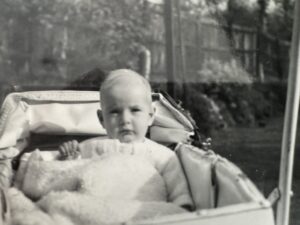
Mary as a baby
I was born on the 13th of May 1957 and adopted at six weeks old by Jean and Philip Lee-Woolf. My new mother and father were a clergyman and a doctor and they already had another child, my brother. He was also adopted and was 18 months old at the time.
I can’t remember a time when I didn’t know I was adopted. I have a vague memory of my Mum telling me “your mother was a nurse who was too poor to keep you”. That was the “official” story and I think it’s all I knew for a long time. My Mum also told me that “we chose you” which, I think, adoptive parents often said to their children in those days. I understand that this was meant to make the child feel shiny and special but it’s always struck me as a double edged idea. Yes, my parents chose me but what if they hadn’t? There’s also a strong gratitude element that comes with that narrative. It’s a lot to live up to. I’m glad that today’s adoptive parents are supported in life story work and seem more aware of how powerful words can be.
I’m not sure I really understood what being adopted meant at first. When I was angry with my parents, I would dream of being a princess and I used to think that if my parents hadn’t adopted me, maybe the Queen would have done! My parents were very loving and I feel very lucky to have had them. But I was always acutely aware of being different from other in all sorts of ways. For one thing, my Mum and Dad were much older than everybody else’s parents. So, when I went to school people used to say “are they your grandparents?”. I thought, “why are they different? Why am I different?”.
Unfortunately, I stood out for other reasons too. My parents and brother were very bright academic people but I really struggled at school. I later found out that I was quite severely dyslexic and had dyscalculia. But in those days the teachers just assumed I wasn’t very clever or wasn’t trying hard enough. In fact, I had a photographic memory and was very creative but found maths and English really tough. I was too embarrassed to say, “I don’t understand” or to ask for help. So I developed other strategies for getting by. Like cheating and being the class clown. I also had a deal with one of my classmates where I’d do all his drawings and he’d let me copy his maths work. This arrangement worked well for about four years until we got found and I failed the 11 Plus examination. This was a huge blow as I’d been expected to go to grammar school like all my other friends. My parents tried their best we but they had no understanding of anyone who wasn’t a natural academic.
All my family were academics – my mother, my two uncles, my auntie and my father’s brother were all doctors. I felt like the black sheep of the family and that everyone around me just didn’t get me. There was love in the home but no real understanding. Plus, my Dad had a serious drink problem which made everything more complicated.
During the secondary school years my parent’s expectations of me became very low. They said to me, “We don’t mind if you don’t get any O Levels. We know you will have tried your best”. And I thought, “You think I’m stupid”. They couldn’t seem to fathom why I wasn’t like them and their disappointment reinforced my feelings of being different. I felt so unsupported at home and at school. I decided from the age of 11 that I wanted to be an artist and used to draw all time. Unfortunately, my art teacher didn’t take any notice of my work, even when I won a local prize. When I left school at 16 and went to art college, I remember thinking this is like a dream come true. Although, I once overheard my dad saying to a friend who came round to dinner, “would you believe you can even get a degree in art these days?”. I was so upset. These were cultured people, they go to the theatre, they go to art galleries but they don’t see art education as being equal to more academic study. I think I spent my 20s after art college, trying to prove to my Dad that I was worth something.
That continued in one way and another for the whole of his life. Ironically, I’ve spent a lot of my life in academia, I’ve done two Master’s Degrees and spent twenty years teaching at a university. I even wrote a book, which was the worst experience of my life, but maybe an attempt to show my Dad that I’m not stupid. My mother was a very different person. She kind of met people on their level. And my friends always said, “you’ve got amazing parents”. They were amazing and, as a clerygman, my Dad was particularly good with people coming to see him who were in trouble. They were charitable people it’s just that their charity was outside the family.
When I was 27 years old I made the decision to look for my birth mother. My Dad used to read The Times newspaper cover to cover and one day there was an article about somebody finding their parents. I took this opportunity and talked to them about looking into my own history. My Mum said, “I’m surprised you haven’t done it already.” Which surprised me as I’d always been worried about upsetting them.
After getting a copy of my birth certificate, I was able to track down my birth mother by writing to the vicar in the village that she had lived in when I was born. I found my maternal uncle first and he wrote to my mother who was living South Africa. She wrote saying, “what a shock, a surprise, and a delight to get my brother Roland’s letter.” We met up after a few years of writing to each other and it was amazing. Initially. My mother was able to answer a lot of the questions I’d had about the start of my life. She’d been a 22 year old trainee nurse and my father was a student doctor. In those days pregnancy outside marriage was seen as shameful and my maternal grandmother refused to talk with my mother about it. She was given the choice of either keeping her family or her baby – but she couldn’t have both. It was very brutal. Three months into the pregnancy my mother was sent to a home for unmarried mothers in Windsor where she was excepted to earn her keep by cleaning and doing the laundry. When I came along we were moved to the Crossroads Mother and Baby Home in Friern Barnet, North London. She was less forthcoming when it came to telling me more about my father. She said to me, “I’ve moved on and so should you.” I’m not somebody to give up easily and was determined to look for him with or without her help.
In the end it took another two decades to find him. I didn’t even have his full name and all I knew was that he was a medic. After years of research and endless phone calls, I finally spoke to a lovely woman at the Royal College of Surgeons in Dublin. She said to me, “send me an email with what you know and I’ll see what I can do”. She was able to confirm, “off the record”, that the details I’d managed to gather could relate to someone who’d studied there and was now a psychiatrist living in the U.S.A. She was unable to give me any more information for reasons of confidentiality. After that I went online and, because I didn’t have his full name, looked up every psychiatrist in every state of America – until I found the man I believed to be my father. When I contacted the Royal College again their records showed that this man was my father.
After many attempts to track him down we had a great conversation on the telephone. This was followed by a very painful five years of silence from him. When we eventually met we began what became a wonderful relationship. I felt that, at the age of 55, by meeting him, I’d gone from being a girl to a woman. He accepted me for who I am and loved me unconditionally. He had his flaws, as we all do. He was a recovering alcoholic and had made his life about treating other addicts becoming the chief psychiatrist for the Betty Ford Clinic in Los Angeles. He was a quite a character but he was an honest man.
My father told me his side of the story surrounding my birth. It turned out that I was the result of a drunken liaison and it was the first time he’d ever been with a woman. My mother later told me that, after what happened, she barely ever drank again. I think the whole experience of being pregnant with me really damaged my mother. She was so ashamed. Even now she won’t say to people that she has an adopted daughter. She says, “I tell everyone, you’re my niece”. I think my father would have married her if things had turned out differently. Apparently there was some kind of miscommunication and she never received his letters.
Physically, I’ve got bits of both my biological parents but I’m the spitting image of my father. Sadly, I don’t have my mother’s hands, which are beautiful. I’ve got her ankles and I never liked my ankles! My father has died now but I still have a good relationship with my birth mother. I have to say, after getting to know her properly, there are things about her that made me thankful for the family I grew up in. We have very different values.
Despite the disappointments, meeting my biological parents was like finding the missing piece of a jigsaw. Finally I could see the complete picture. I was a whole person. Until then I’d always had feeling of incompleteness and I was terrified of being rejected. This has affected my romantic relationships and for years I’d always choose unavailable men. I now realise that I’ve spent a lot of my life trying to fix other people. Perhaps unsurprisingly, I ended up marrying an addict. We divorced, eventually, but we have two gorgeous children who are now adults. One’s a musician and the other’s an artist.
I’m now in my late 60s, and finally on the way to fixing myself. After years of being a single Mum I’m doing the creative things that I’ve always wanted to do. I write and make films and I’m happier than I’ve ever been. Life is busy, I have lots of friends and I’ve discovered that it’s okay to be with people who are good and nice and loving.
Being adopted is very difficult to explain to someone who hasn’t been through it. Adoptees can experience very particular feelings of being misplaced, dislocated and rejected. Healing can come with finding one’s birth parents, as was the case with me. But there can be lots of heartache along the way. Maybe if I’d had proper information and photographs, I wouldn’t have grown up with such an acute sense of being different. Honesty and transparency are crucial for someone trying to make sense of their life. My parents did their best but there was no reference point for them. Today’s adoptive parents are so much better equipped to help their children with life story work. It’s so important that they’re supported in this. There’s still so much confusion and ignorance around adoption. The only way to change that is by raising awareness and encouraging greater understanding of what it can mean to everyone involved.