My mother was born in 1919 to a 16 year old girl. Through Ancestry and other records we’ve discovered quite a lot about her birth mother. Her name was Violet. She was just sixteen years old and came from a family in Kent. She went to a St Michael’s Fellowship home to have my mother. The records say she was admitted after a violent assault, so whether she had been raped or whether the family were covering something up, we don’t know. What is clear is that it wasn’t a happy time for her.
At that time, the rules at St Michael’s Fellowship required mothers to stay with their babies for six months. It was almost a form of penance—you couldn’t simply give your baby up straight away. You had to stay and care for them for six months. So Violet would have stayed with my mother for that time.
After that, there’s a missing year. We have no idea what happened until my mother appeared with an adoptive family in South Wales. A lot of the records have been lost, so we don’t know how that came about.
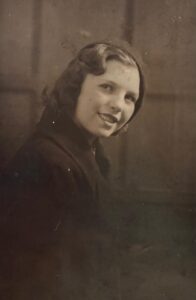
Molly aged about 15 in the 1930s
My mother was named Mary at birth, but was known as Molly in her adoptive family. She was by far the youngest child in the family. Her adoptive brothers were already almost adults, and her adoptive parents were actually older than her biological grandparents. Those of us in the family who became fascinated by the story would love to know why that particular couple adopted a little girl at that stage of their lives. We’ve come up with all sorts of theories, including whether they somehow knew her birth family, but we have no evidence at all.
Over the years, my adoptive grandmother has become one of my heroes. Whatever her reasons were, she took on a little girl and raised her.
My mother always told the story of how she discovered she was adopted. She and her mother were walking around Swansea when they met a woman from another part of town. The woman said, “Oh, this is the little girl you adopted.”
My grandmother immediately held onto her and replied, “No, no, this is my little girl.”
My mother must have been about four or five. She said she had no idea what the word “adopted” meant, but she knew instinctively that it referred to her because of the way the conversation happened. From that moment she knew, even before she understood what adoption actually was.
She never said anything. She never told her parents that she knew.
There were moments throughout her life that reinforced it. When she started work, she had to produce her birth certificate to prove her age, but her family insisted on taking it in for her. So she always knew she was adopted, but it was never acknowledged within the family.
Her adoptive father died suddenly from influenza when she was still very young, around four or five years old. My adoptive grandmother was left with no money at all. This was the early 1920s. She went to the council and explained that she had adopted this little girl, that she was now widowed and working two cleaning jobs just to survive.
The council’s response was that they would simply take the child back into care.
My grandmother refused. She said they were not taking her. She continued working two jobs and somehow managed to keep and raise my mother.
That became one of the defining stories in our family.
My mother didn’t tell me she was adopted until I was a teenager. Even then, she was still frightened and ashamed. She carried a deep sense that she didn’t really belong and that, somehow, somebody might come and take her away. That anxiety was always there in the background.
When her adoptive mother died, something else happened that stayed with her. One of her older adoptive brothers’ wives had become the family matriarch. My mother found her burning a pile of papers in the fire. She explained that she had promised my grandmother she would destroy them because my grandmother never wanted my mother to know anything more about her origins.
We’ll never know what those papers contained.
When my father proposed to my mother, her family took him aside and warned him that they couldn’t guarantee where she had come from. They suggested he might not want to marry her because of her unknown background and genetics.
My father wasn’t troubled by that at all. The irony was that my mother already knew she was adopted—they simply didn’t realise that she knew. They were telling him, but still not telling her.
That story had a huge impact on our family. My mother was an extremely anxious person, and it’s not surprising when you think about what she had lived with.
At first, she was very unforgiving of her birth mother. Once she’d had children herself, all she could think was, “If someone had tried to take one of my children away, I would have fought them.” She simply couldn’t imagine any circumstances in which she would have given up one of her own children, so she felt very angry with her biological mother.
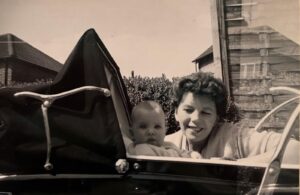
Molly and her daughter Jacqui as a baby
Over time that changed. I think my niece and I spent a lot of time talking with her about the realities of life for unmarried mothers in those days. We would say, “Perhaps she had no choice. Perhaps there were circumstances you don’t know about.” Gradually she softened.
Even so, she was reluctant to investigate her origins because she worried her birth mother might still be alive. She feared that if she found out too much she might somehow be forced into meeting her, and that wasn’t something she wanted. Looking back, it probably wasn’t a realistic fear, but it felt very real to her.
She also worried that her birthday might not actually be her birthday. She had no proof that the date she’d celebrated all her life was correct, and somehow the thought that it might not be undermined her sense of who she was.
As the years went by, though, my mother became much more relaxed about the whole subject. The threat she had always felt seemed to diminish. Her family had become openly interested in the story rather than treating it as something shameful. We didn’t see adoption as reflecting badly on her in any way. We simply thought there was an interesting family story to uncover, and we were curious about it rather than looking to blame anybody.
I think that acceptance helped her enormously. Being able to talk about it openly, without shame or secrecy, allowed her to process something she had carried for most of her life.
Eventually we persuaded her that we could at least begin by looking for her birth certificate. While she was still alive, we thought we’d identified her birth mother, who had already died. We believed she came from Milton Abbas in Dorset, which is an absolutely beautiful place, and we went there to look around. We couldn’t find much information about her or establish any convincing link, but my mother embraced the story. She found it comforting and interesting to imagine that this beautiful village was where her mother had come from.
It later turned out that we were completely wrong but by the time we discovered the mistake, my mother had died.
The error happened because my father had searched for women who would have been between eighteen and forty when my mother was born. We assumed her birth mother would have been an adult, but in fact she had only been sixteen, so we had excluded her from the search without realising it.
We’re still piecing parts of the story together. Through DNA testing we’ve now identified the family my biological grandfather almost certainly came from. We’ve narrowed it down to two brothers, although we can’t say with complete certainty which one it was.
There are still so many unanswered questions. The people who might have known simply didn’t talk about it, and those who are still alive know no more than we do—probably less, in fact. It’s tempting to invent explanations. You wonder whether there must have been some connection between the two families to explain how my mother came to be adopted by them, but we simply don’t know.
What I do know is that my mother’s experience gave me a first-hand understanding of the impact that very early childhood experiences can have on later development. I saw how things that happen before a child has any conscious memory can still shape the rest of their life, and how those effects can ripple across generations.
That understanding became central to my professional life. I worked as a child psychiatrist, and within that I developed a particular interest in adoption and kinship care. I ran groups for adoptive parents and kinship carers because, by then, I was also an adoptive parent myself. I was fortunate to be in a position where I could develop that area of work, even though it wasn’t a common part of child psychiatry. Interestingly, my niece also went on to work with children who had experienced early disruption and those in the care sysyem.
My personal experience and my professional life became entwined when I became an adoptive parent myself. In 2003 my then husband and I adopted, through Coram, a little girl aged three and a half. I already had three birth children but I’d always wanted to adopt if I could.
My daughter, Hayley, had a very difficult start and had already lived in six different places before she came to us. She’d suffered a head injury while in the care of her birth parents and has an autism diagnosis. She’s a lovely person but she had very significant behavioural difficulties that we had to work through together. She found school extremely difficult. She stood out, she was bullied at secondary school, and in the end my professional knowledge helped me navigate the system and find her a tiny specialist school. It was much more like a family environment and she really thrived there.
Today we have a great relationship and at 26, Hayley has just had a baby of her own. Now I’m a grandmother. My granddaughter is eight months old, and she’s the first grandchild in the family. When I look at her I see the whole story come full circle. My adoptive grandmother changed my mother’s future. My mother changed mine. I was then able to adopt Hayley, and now Hayley has her own daughter.
That, for me, is what adoption is really about. It’s about changing family stories across generations.
For adoptive parents today, the challenges are immense. That’s why organisations like Coram are so important. Long-term support for adoptive families is absolutely vital, because these adoptions are never going to become simpler. We’re not going back to an era when healthy new born babies were routinely relinquished. Modern adoption will always involve complexity, trauma and loss, and families need ongoing support to navigate that.
Do I still believe adoption is the best option? For young children, yes, absolutely. Everybody needs a family. Having people who remain your family into adulthood—who become grandparents to your children—is a fundamental human need. Foster care can be extraordinary, and some foster carers maintain lifelong relationships, but adoption offers something different: permanence.
Of course, adoption isn’t right for every child. Some young people simply can’t be contained within a family home. Even with all my professional experience, excellent support and knowledgeable friends, there have been some very challenging times over the years. It’s incredibly demanding. But where the right match can be made, I still believe it’s by far the best option.