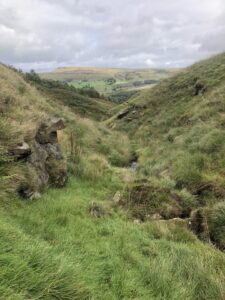
Carol and her family love to walk in the Yorkshire hills.
My husband, Matthew, and I came to adoption after finding out that we couldn’t have birth children. We’d only been trying to start a family for about 18 months to two years before we found out that it simply wasn’t going to happen.
We talked about adoption for quite a while before I made the phone call to social services. We understood that adopted children would need a lot more nurturing, a lot more understanding and, potentially, specialist support. This wasn’t going to be ordinary parenting; it would be parenting with additional challenges.
We knew ourselves and each other well and I think we recognised that we were both resilient as individuals and as a couple. One thing that was very much in our minds was that, if this was our only chance to become parents, we didn’t want to look back with regret because we hadn’t taken it.
So we took the plunge and went through the process. We had our initial visit in the Summer of 2004, completed our preparation course in early 2005, and were approved at the end of November 2005 to adopt one child aged between 18 months and four years.
Then we had a very long wait, which people often say is the hardest part of the whole process: waiting to be matched and waiting for that phone call to say there was a potential match.
That call finally came on 8 June 2006, just over 20 years ago. It was about a little boy who was just under 18 months old and needed a new family. He’d had a difficult, traumatic start in life and needed to be placed away from his birth family. We’d been identified as a potential match.
We met him for the first time two days after his second birthday, and he moved in with us a week later. Looking back, it was a remarkably quick transition from meeting him to him becoming part of our family. At the time, it was felt that moving quickly would be better for him. It was a real physical shock as well as a psychological one, and we hadn’t been prepared for that at all.
People always tell you about the impact of becoming a parent, especially becoming a parent very suddenly, but nobody really prepares you for the bone-tired exhaustion. I remember somebody saying that, if you have a new born baby, they don’t weigh very much, and as they grow you’re constantly adjusting to the extra weight. With a two-year-old, though—especially one who’s quite sturdy and stocky—you suddenly find yourself carrying a child who weighs quite a bit. The physical impact of suddenly parenting a toddler was immense.
I think the adoption process prepares you for the big things. It prepares you for conversations about identity, birth family and trauma. But it doesn’t prepare you for that feeling of panic when you’re out in public and suddenly realise you’ve got to get this child into a pushchair or a car seat, when you’ve only done it a couple of times before in your life.
I remember the first time we took out our son on our own. It was during the introductions process. We went to a park and then to a café and afterwards we had to get him back into his car seat without the foster carers there to help. I’m sure people thought we were kidnapping him. We looked like complete amateurs. We hadn’t a clue what we were doing, although we managed it in the end.
In a sense adoption is “instant parenthood” – you miss out on everything that comes before that point. One of the most challenging things is not having the opportunity to influence your child’s earliest experiences. As adopters, we’re bonding with, getting to know and supporting a child whose early life we often know very little about.
That really hits home when you start going to toddler groups and meeting other parents. You’re listening to conversations about feeding, sleep routines, discipline, education and play—decisions those parents have been able to make for their children from the very beginning. Many of those choices have effectively been made for us because, during the transition from foster care to adoption, the priority is keeping as much as possible familiar for the child. We know the move will be traumatic, so we try to preserve routines and minimise further disruption. Sometimes those everyday parenting choices feel like real luxuries because we simply haven’t had the opportunity to make them.
One moment that stands out from the early days is the first time I took him swimming. His foster carers had always said he loved swimming, so I organised everything—swimming trunks, water wings—and took him to our local pool, which is lovely: warm, shallow and very child-friendly.
He was absolutely terrified. He clung to me the whole time. Looking back, what struck me wasn’t that he was frightened of the water, but that he wanted me to be the person who made him feel safe. He wasn’t interested in running around or going to anyone else. He wanted me. That felt significant.
I remember how, at first, he called both of us “MummyDaddy”. It was one word and it referred to both of us. Eventually he worked out that I was Mummy and Matthew was Daddy but for quite a while we were simply “MummyDaddy”.
There were lots of little moments like that, and they nearly always centred on him seeking safety. He went through a phase of struggling to sleep and wanting Matthew with him during the night. Then he went through a phase of waking at five o’clock every morning and wanting me. We gradually realised we each had our own role in helping him feel secure.
Another thing that stands out from those first few weeks was how he developed little rituals to help ground himself. He would take one of us by the hand and lead us through the entire house, going into every room to check that everything was still there. He also carried little toys around with him everywhere he went. It felt as though he needed to reassure himself that everything was where he expected it to be. Partly that’s about object permanence—learning that things don’t disappear just because you can’t see them—but I think it was also about suddenly being in a completely unfamiliar environment and wanting to make it as predictable as possible.
One of the things he would do on those little journeys around the house was try to cram as many toys into his hands as he could. They were usually small things—a little wooden animal from a Noah’s Ark we’d bought him, toy cars, anything he could carry. Looking back, I think it was his way of reassuring himself that these things were his and that they weren’t going to disappear.
It’s also been really interesting watching him explore that sense of identity as he’s grown older. From quite a young age he became fascinated by Vikings. Part of that was probably a school project, and part of it was Matthew’s interest in history—we’ve always taken him to museums and historical sites. Then, when he was 18, he wanted to do a DNA test. It turned out he’s 19% Norwegian, and that really resonated with him. Since then we’ve been to Shetland and to Norway, and exploring that Norse heritage has become an important part of how he sees himself.
Helping him develop that sense of identity has been important. Sometimes it’s connected with experiences we’ve shared as a family, and sometimes it isn’t, because of course those aspects of his identity don’t come from us. But we’ve tried to help him explore and grow into who he is.
As is often the way with adopted children, formal education was a challenge. We were fortunate that there were a few teachers who really understood him and understood the impact of his early trauma. I think teachers today are generally much better informed about trauma now than they were then. His secondary school was better, although COVID disrupted so much of that experience. But in primary school, many of his teachers—and unfortunately the headteacher as well—took the view that because he was adopted and now safe, everything was in the past. The attitude was, “Let’s draw a line under it and move on.”
We had countless meetings explaining that it wasn’t that simple. We sent articles, website links and information about training, but there was still a lot of resistance to the idea that he needed additional support.
One thing that really sustained him throughout school was music. From a very young age it was obvious he had a remarkable talent for guitar. A close friend of ours had a son who was an excellent guitarist and always let our son play with his instruments. We have a photograph of our son, aged about two and a half, holding a ukulele and looking absolutely delighted. As soon as he could get his hands on a stringed instrument, that was clearly where his passion lay.
Neither Matthew nor I are particularly musical but we made sure our son always had an instrument and music lessons. At school he became known as the boy who was brilliant at guitar. He played at concerts and assemblies, and that gave him a real sense that he had something valuable to contribute—something that made him stand out in a positive way.
As he got older, that identity only became stronger. Guitar was very much his thing.
Academically, though, it was clear he was never going to fit a conventional mould. He had what I’d describe as a spiky profile, and after 30 years of teaching I recognise those children almost as soon as they walk into a classroom. Schools are much better now at recognising the importance of helping those pupils feel safe and valued, but sadly that wasn’t always our experience.
There were many conversations about whether we should move him to another school, but we were always conscious that another move could bring yet more upheaval into his life. Ironically, the teachers who really understood him seemed to arrive every other year. He’d have a wonderful teacher and we’d think everything was finally going to be all right, only for the following year to bring someone much less understanding. Then another excellent teacher would come along the year after. It felt like an ongoing cycle.
I think a lot of parents of young adopted adults and older teenagers would say there’s a real difficulty in getting these young people the support they need once they reach 18 and become adults. They often don’t have the skills, particularly the executive functioning, to do all the things society assumes young adults can do almost seamlessly.
Over the last few years I’ve found myself thinking more and more about adoption in a broader as well as a personal sense. I think this is what led me to write my book. I was very aware of the adoption stories in the media—in soap operas, films and novels—which tend to present a very stereotypical view of adoption. Really, there are two stereotypes: the fairy tale or the horror story.
I wanted to say that it’s far more complicated than that. Moreover, these stories are about a minoritised group of people who have experienced immense trauma and are often still living with its effects. They’re being portrayed in a stereotypical way, and if this were any other minority group—whether a particular ethnic minority, people with a disability, or anyone else—it would be seen as completely unacceptable.
We are very careful in schools, and there has been so much work to make sure the texts we teach are more diverse and sensitive to people from different social groups. We’re thinking about representation, but we’re also thinking about accurate representation. Yet none of that sensitivity and thoughtfulness seemed to be applied to adoption.
I wanted to push back against that and say that it isn’t okay. There are still children going through foster care and adoption, birth parents losing their children to adoption, and adoptive parents supporting those children. We’re living lives that involve challenges the mainstream media simply doesn’t understand.
When people with no understanding, knowledge or experience of the adoption system think about how it works, they often think very much about these poor people who haven’t been able to have children and are somehow owed a child because there are so many children out there who need loving homes.
It can almost seem as though adoption is a kind of act of social justice where people are given the children they want. I wanted to turn that around a bit and say, actually, the social justice is about helping the children who need families, for whatever reason they need them.
So many people’s views of adoption are still shaped by the way things were in the 1960s and 1970s, when it was often about very young babies being given up for adoption—whatever “given up” might encompass, because, as we know, it was not always a voluntary process. There was a great deal of coercion involved.
I wanted to explore how things have changed over the years and the fact that adoption today is very different from the way it was in the mid-20th century, for all the reasons we’re aware of. In the course of writing the book I had so many meaningful conversations. One was with a retired family court judge who talked to me about her experiences. She was very useful in helping me understand the legal side of things, but one of the things she talked about was the fact that every case she had heard had stayed with her in some way.
She talked about the sense of making these momentous decisions about people’s lives and the responsibility that came with that. She was very aware that, when she made adoption orders and placement orders, she was bringing about a bereavement. She knew she was doing it for the benefit of those children and that it was in their best interests. She kept coming back to the words “nothing else will do”. But she was also aware that there was a parent, or two parents, on the other side of that decision who would experience a very particular kind of loss.
It was a bereavement because they knew their child would be growing up somewhere without them. And it’s a kind of bereavement that is very difficult to talk about because there is often a sense of shame and guilt attached to it, with all those different layers of emotion. I think that was a really powerful thing.
I also spoke to a woman who works for Pause, which works with mothers who have had a number of children removed by the child protection system, including children removed for adoption. I talked to her about these women’s experiences as they try to rebuild their lives and the work that Pause does with them.
Often, that work is about practical things like housing and self-esteem, but also supporting women who struggle to function in society and who are facing enormous challenges. The odds are often stacked against them.
I think it’s easy for adopters—and I remember there being some of this when we were on our preparation course—for there to be an “us and them” feeling between adoptive parents and birth parents. I hope my book goes some way toward bridging that gap and dispelling some of the myths that still surround adoption.
https://www.penguin.co.uk/books/470915/so-many-ways-to-belong-by-atherton-carol/9780241767290