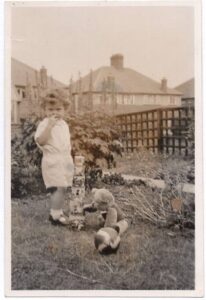
Anthony as a boy
It is a hundred years since the landmark 1926 Adoption of Children Act which began the development of a much-needed structure and infrastructure for adoption. I was adopted 23 years after that, in 1949. If we take a possible lifespan today of 100 years – I should be so lucky – I am now in my final quarter so my story is a snapshot of the relevance of my adoption in each quarter century of my life – 0-25, 25-50 then 50-75. I end with a reflection about quarter 4 which is already flying by.
0-25 was an emotional rollercoaster from which I have yet to completely recover though I am 90% there. This period of my life contained enough trauma and misery to leave a lasting impact which I have been largely able to successfully mask. The trauma has impeded my relationships across my lifespan though not my work. I found out I was adopted when I was 8, by chance. I experienced this as a profound breach of trust which was intensified as I felt I was in the wrong place from then on. The relationship between my adoptive parents was abusive and this is the main reason why the breach of trust did not resolve quickly. My adoption was regulated but as my adoptive mother said of my adoption through a local church, “they – the assessors – were mostly interested in whether the toilet was clean and how big the garden was”.
By 25, I was married and in a stable career which has continued to this day. My wife of a fabulous 52 years and counting, helped me to find my birth parents. This helped me to understand and to come to terms with why I was adopted. I was driven to find out by more than curiosity. However, my emotional longing could not be addressed by suddenly and magically becoming a child of my birth parents at 27. I am still in touch with some members of my birth family and gave a speech last month at my birth half-sister’s 70th birthday party. I’m also in touch with chosen relatives on the adoption side of my identity. These are not close relationships. The only close relationships I have is with my wife, children and grandchildren. But that is not unusual.
The years from 50-75 saw an easing of my adoption burden and distortions. I gradually became more capable of a normal approach to life which I was still learning actively every day. Growing up unhappily adopted is the same as growing up unhappily anywhere – it is a perpetual present to survive and an emotional shut down which is painful and hard to release oneself from – a Stockholm syndrome. I should add that I look back on the quarter, q3, with an immense sense of personal and professional achievement and a pleasure in the growing success and happiness of those around me.
I also grew to understand my adoptive parents more. I stopped condemning them.
I was not at all defined by my adoption in this period. My own lived experience confirmed for me the importance of adoption for some children and the importance of choosing the right adopters and giving placements proper support. Had my family been supported, we might well have solved many of our problems that were too powerful and overwhelming to face up to and tackle ourselves.
So what next as I enter Quarter 4? Two recent contacts are relevant. One of my nieces on my adoption side went public about the trichotillomania she has been experiencing and addicted to since childhood. She pulls out her hair but then I pick the skin off my thumbs, sometimes violently – part of the childhood legacy still going strong at 76. Perhaps our two conditions, mine being classified as dermotillomania, are a coincidence. I’m going to Kos in September to spend some time with my birth half-sister and one of her children who is Greek. So contacts continue, globally, like so many family networks now.
I remember when I chaired BAAF that we sometimes had calls from adopted people in their eighties and nineties, wanting to know the truth of their background before they die. I’m pleased I got over that hurdle in my twenties. Adoption legislation and practice has changed for the better continuously since 1949. Instead of ‘the biological pretence’, we recognise the importance of understanding your birth and your heritage. Instead of assuming adoptions don’t need any support, we now recognise they do, especially therapeutically, at key junctures of childhood. Adoption is a small but significant option in care arrangements for those children who need security, stability and a lifetime attachment. I am glad that for children being adopted today, they will not have to automatically endure some of the pain and trauma I experienced, mostly avoidably.
I work overseas as well as in the UK. In many jurisdictions, adoption remains a political hot potato, because of historic forced adoptions and stolen children, to name just two of many ancient violations – well not so ancient as some practices were still the norm only forty years ago. Even open adoption has a finality about it which is fraught with risk, but then so is leaving children abandoned in local care systems which still happens far too much. That is a children’s rights issue. I am glad that adoption is not so weaponised in UK law and practice and that it is still a viable option for those children who have no family alternative and who need love, attachment and a positive future. I remain thankful to my adoptive parents for not standing in the way of my own future. I go into my last quarter content that I was adopted and that I have become stronger and more resilient – and I hope a nicer person – as a result of working through everything that happened to me in that crucial first quarter. I might even hire Nicole Kidman as my death doula. The world is getting stranger.
Anthony Douglas was Chief Executive of Cafcass, the national agency charged with articulating the voice of the child in family courts throughout England, from 2004-2019. Since then, he has run a small business focusing on system leadership and rapid improvement, including working as a Children’s Commissioner for DfE and supporting overseas jurisdictions in child and adult protection through the Foreign Office. He was awarded a CBE in 2008 for services to family justice and adoption and has been a Governor of Coram since 2019.