It was May 2003 when I gave birth to my son. I was 17 at the time, very young and naive. I had been to the doctors because my periods had stopped. They did a pregnancy test, which came back negative. I also had chronic health issues., so the doctors suggested my periods might have stopped because of that. I didn’t give it a second thought. This would have been late 2002—maybe October, November, or December. I’d started a new job in January, completely unaware I was pregnant. I even did my own pregnancy tests at my old job, which were also negative.
In February, one evening, my mum came into my room. We were messing around tickling on the bed. After leaving for a few minutes, she came back and said she thought I was pregnant. I was embarrassed; we had never had conversations about sex or periods. She then dragged me to Sainsbury’s to buy a pregnancy test, along with some apples and bananas as a cover. I did the test at home, and it was instant—it confirmed I was very pregnant.
My Mum told me to wait two minutes, and when the time was up, she confirmed it. My Dad wasn’t home because he worked night shifts. Mum panicked a bit and told me not to tell him. My sister was at home, but I’m not sure how much she knew. We agreed to sleep on it and talk in the morning. It turned out that when I spoke to my Dad the next day he was very supportive. He told me I wasn’t in trouble and that we’d figure it out together. We went to the hospital and I discovered I was seven months pregnant. The doctor was blunt and unsympathetic, telling me the only option was to give birth. Social services quickly got involved, visiting our house and spending time with me to ensure I wasn’t being pressured by my parents.
My mum said I could keep the baby, but I would have to move out and live on a council estate—a place I was raised to think of as undesirable. It was framed as a choice, but there really wasn’t one. Social services arranged meetings with prospective adoptive parents. They were careful, taking me out for lunch and showing me profiles of potential families. I chose a couple who had their own daughter but were looking to adopt because of genetic issues with their child.
I met them before giving birth. The meeting was awkward, with social services, my parents, and me in the room. The adoptive father was socially awkward, which added to the tension. But I felt it was the right thing to do. I don’t regret my decision, though now, with my own son, I think about it differently.
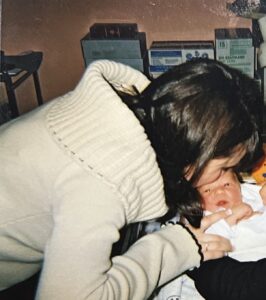
After I gave birth, my son stayed in the hospital for about a week. Apparently there was a risk of some kind of infection and he needed intensive antibiotics. The plan had originally been that he would be taken away immediately to avoid attachment, which I accepted. I’d gone through the labour alone, with gas and air and kept my eyes shut the entire time. Until the moment he was born when I opened my eyes for a split second and watched him being taken away.
During that week in the hospital, my Mum insisted we visited daily. I think she was trying to “do the right thing” but seeing him was incredibly difficult. My Dad died 18 months later, and honestly, leaving my baby in the hospital was much worse than losing my Dad. Which sounds awful to say out loud. There was a biological urge to connect with my son but my conscious thoughts were, “What am I doing? I’m not a Mum.” The connection we’d made didn’t fully hit me until I said goodbye. It was traumatizing and certain things are definitely blocked out.
I do know that I struggled to settle back into normal life and looking back at my medical records, there were multiple occasions where my Mum had called the doctor saying I needed help. I sometimes got very angry and needed support. Unfortunately, I never actually received any. Social services completely disappeared once the baby was born. I never heard from them again.
The adoptive parents maintained letterbox contact for 7 or 8 years. So I was able to get some sense of how my son was doing. I also learned that the family moved to another country in Europe. Eventually contact stopped.
During the lockdown, I decided to try to find my son. By this time I was in a long term relationship and had another son. I’d always thought that making contact wasn’t up to me. But COVID seemed to change everything and I worried that he might want to find me but not know how. I joined a Facebook group where people search for others and began corresponding with a woman in the group who offered to help. Within half an hour of searching she had found the family. I then identified his name through social media and sent him a message, simply saying I was looking for a child born on a specific day—not claiming to be his mother. I waited a few days but didn’t get a response.
Coincidentally, that year we were going to on a holiday to the neighbouring country of where they moved to. A treat for my partner’s 40th birthday. We were staying at the very north of the country which was close to the bridge that links to where he lives. I decided to write a letter to him and post it when we walked over.
The next week I was getting my nails done back in England and a message popped up on my phone. Luckily, the nail technician is a friend, so I quickly checked the message and saw his name. He wrote, “You’ve got the right person.” I got goosebumps—it was unreal.
I replied, and he asked whether we could talk in half an hour when my nails were finished. After finishing, I called him from my car, and we talked for an hour and a half. It was just chit-chat at first—work, hobbies, everyday life—like talking to a long-lost friend.
We talked about his work—he’d been a mechanic but now works in construction. It turns out he’d asked to find me a few times, but his parents weren’t supportive, so he didn’t know how. He was really pleased when it finally happened.
At first, we both became obsessed with messaging each other constantly. It got a bit overwhelming for me because I’m not naturally that way—I prefer brief conversations—but it gradually balanced out. We exchanged messages, photos, and video calls, and then came the point where we were able to meet. Of course I had to tell my younger son about him. When I did, he was calm and not overly curious. He didn’t have questions and I think he may become more curious when he’s older or has children. But for now, he was accepting and that was all that mattered. I was so relieved to be able to tell him.
Four months after we first made contact my son flew over and he came to stay with us for a week. It was just normal, not awkward at all. We’re still in regular contact. He loves cars, as I do. A couple of days ago, I messaged via Snapchat from a car show. He replied with a picture of himself at the dinner table with his girlfriend—that’s how we communicate these days.
Having met my son, I see things differently. Literally. For a long time I would look at his photos and feel nothing. But now I do—it’s changed entirely. It’s like it was someone else’s story before, not mine. Now, it feels real in a way it never did.
I know that what I went through has profoundly affected me. For years, I was just existing rather than living. My body has stored a lot of trauma and it’s something I’m still dealing with. I’ve been diagnosed with borderline personality disorder, which is often linked to childhood trauma. Although that’s usually associated with much younger children, I was still a child at 17.
I think it’s really important to tell my story, especially because people in my position don’t often speak out. There’s a lot of fear, judgment and shame. You hear a lot from adoptive parents or the children, but not often from someone with my experience. Knowing that other people might read it and relate to it, or feel helped by it, makes it worthwhile.
The media often portrays adoption badly—EastEnders, crime stories, adopted kids turning up angry or violent. That’s damaging. There are good stories but they’re rarely told.
Despite everything I don’t regret the fact my son was adopted. I might not have met my partner or had my younger boy. Could I have raised him myself? Absolutely. But he’s had a very good life and I’m thankful for that. I just regret how it was handled at the time. Hopefully things are done differently now.